

“How much water does WSU really need? And if the university is getting by with less water, why are its administrators spending tens of thousands of dollars on attorney fees to protect paper water rights that they do not need? What do they plan to do with these rights? Sell them?”
- Scotty Cornelius
Website contents:


Fossil Water. Irrigating WSU’s new 18-hole golf course with water from the Grande Ronde Aquifer. Scotty Cornelius photo

Home | Contact Us | About Us | Join CELP | Ralph W. Johnson

Center for
Environmental Law & Policy


WSU water rights challenge
A local alliance of water conservationists were in Whitman County Superior on June 6th, challenging Washington State University’s legal claim to far more ground water than it has ever used.
The court heard an appeal in their lawsuit, which was prompted by WSU’s expanded pumping to irrigate the greens of its Palouse Ridge Golf Club. The suit is a test of the state’s Municipal Water Law, with implications far beyond the Pullman area, where the ground-water level is dropping.
Under western water law, holders of water rights must either use the water or relinquish rights to the water: use it or lose it. WSU wants to increase the amount of water it pumps from the aquifer beneath the university to irrigate an 18-hole golf course. In the last century the State issued water rights to WSU that went unused. When WSU applied to the Department of Ecology (DOE) to transfer its water rights, the state agency should have required the state university to forfeit rights to its unused water. Instead DOE granted the new water rights to WSU.
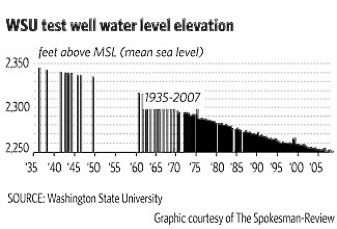
Since measurements were started in the 1930s, water levels in the Grande Ronde Aquifer have been declining 1-2 feet per year. 50,000 people in the university towns of Pullman, WA and Moscow, ID and in outlying areas depend on this water. Washington State is permitting WSU to mine this aquifer in violation of state law. The WSU water rights decision would accelerate the mining of the Grand Ronde Aquifer. Local citizen groups -- concerned about their communities’ water future with a declining aquifer -- challenged the DOE’s decision.
The case, Cornelius vs WSU, is the first water rights case to test a State Supreme Court decision last October on the 2003 Municipal Water Law. In Lummi Nation vs. State of Washington the Court the law was constitutional on its face, but reaffirmed the Supreme Court’s prior decisions on relinquishment and water rights for municipalities. The Court specifically referenced the WSU water rights case as one it was not deciding.
In 2006 Scott Cornelius, the Palouse Water Conservation Network, and the Palouse Group of the Sierra Club appealed DOE’s decision on the WSU water rights. In 2008 the administrative court that hears such appeals, the Pollution Controls Hearing Board (PCHB) ruled in favor of WSU and DOE. Conservationists delayed their appeal of the board’s decision while awaiting a challenge to the Municipal Water Law . On March 25, conservationists filed their opening brief in Colfax in state superior court, starting the next chapter in their multi-year challenge to protect community drinking water supplies.
WSU officials hope to use reclaimed water at Palouse Ridge, but have not been able to secure state funding to build a pipeline from the Pullman water treatment plant.
The Superior Court hearing is set for 1:30 p.m. June 6 in Colfax. Plaintiffs in the appeal are Scotty Cornelius, Palouse Water Conservation Network, and the Palouse Group of Sierra Club. These citizens are represented by public-interest water lawyer Rachael Paschal Osborn, with the assistance of the Center for Environmental Law & Policy (CELP).