Website Contents & Links

 Overview
 Questions & Answers
 Salmon Critical Basins
 WSU & Grande Ronde Aquifer
-  Dewatering the Spokane River
 Documents
 Legal Briefs 
 Media Archive


questionsanswer.htmldocuments/Entries/2003/3/3_Municipal_Inchoate_Certificates.htmlhttp://columbia-institute.org/wsu/WSUhome/home.htmlspokaneriver.htmldocuments/Archive.htmlhttp://www.gordonderr.com/index.php?option=com_content&task=view&id=172&Itemid=627media2/Archive.htmlshapeimage_2_link_0shapeimage_2_link_1shapeimage_2_link_2shapeimage_2_link_3shapeimage_2_link_4shapeimage_2_link_5shapeimage_2_link_6shapeimage_2_link_7

  Center for

  Environmental Law & Policy

Sign-up 
for water action alerts


http://www.celp.org/mailman/listinfo/celpactionshapeimage_3_link_0
  Our Water Programs

•  Restoring Rivers
•  Water Rights
•  Columbia Watershed
•  Governmental Affairs
•  Water Future

http://www.celp.org/water/celpprograms/River_Restoration.htmlhttp://www.celp.org/water/celpprograms/Water_Rights_%26_the_Public_Interest.htmlhttp://www.celp.org/water/celpissues/Columbia_Watershed.htmlhttp://www.celp.org/water/celpprograms/Governmental_Affairs.htmlhttp://www.celp.org/water/celpprograms/Water_Vision_for_the_Future.htmlshapeimage_4_link_0shapeimage_4_link_1shapeimage_4_link_2shapeimage_4_link_3shapeimage_4_link_4

Donate

http://partners.guidestar.org/controller/searchResults.gs?action_donateReport=1&partner=networkforgood&ein=91-1687883shapeimage_5_link_0

The Municipal Water Law

from an Environmental Perspective


Rachael Paschal Osborn


(This article was originally published in the Washington Section of the American Water Resources Association (AWRA) newsletter  May-June 2008)


As the municipal water law (2E2SHB 1338) heads into court, much is being argued about its purported benefits to water purveyors, along with its disruption of the priority system for water allocation.  What is not well understood, however, is the environmental ruin that the municipal water law will soon be causing to rivers around Washington state.


The waters flowing in Washington’s rivers and aquifers are over-allocated.  For most water bodies, claims and rights to the use of water exceed quantities available, particularly when environmental needs are factored in.  The municipal water law exacerbates this over-allocation by allowing increased water use via “inchoate” or “paper” water rights without consideration of what rivers and aquifers are capable of yielding.


A review of basic water law principles helps explain the problem.  The prior appropriation doctrine comprises a set of common law and statutory rules: seniority (“first in time, first in right”); loss for non-use (“use it or lose it”); reasonable efficiency; and no waste.  In 1917, the Washington Legislature enacted these rules into the state surface water code, and in 1945 extended them to groundwater.  Water uses pre-dating these statutes were grandfathered in. 


The water codes established an additional set of rules.  New water uses required a permit, subject to several tests:  water must be available physically; water must be available legally (i.e., a new use may not impair an existing use); the new use must be beneficial (meaning both a productive purpose and reasonable in quantity for that purpose); and the public welfare must not be harmed.


The prior appropriation rules have an important rationale.  The first person to access water (User No. 1) possesses the right to demand that those who come later in time curtail their use.  This is such a draconian power that User No. 1 has reciprocal obligations:  to use water only in quantities actually needed, and to use it with reasonable efficiency.  Water that No. 1 does not need then goes to the next user in line. 


These rules – priority of right, efficiency, and loss for non-use – are correlative.  The priority system is by its nature inequitable, imposing a harsh outcome on junior users when water is scarce.  The rules inject balance into the equation, prohibiting senior users from water hoarding and wasteful use, thus minimizing the frequency of curtailment for junior water users.


Sadly, these rules have been honored more in the breach than observance.  With respect to water availability, the Department of Ecology Water Resources Program (formerly the Department of Water Resources) historically did not formally assess physical water availability, i.e., whether the naturally occurring water budget was adequate to supply new water rights.  Instead, the agency assumed that water was available until users complained, at which point an adjudication might be filed or other enforcement action taken.  But the agency rarely compared the quantity allocated with the amount of water physically available in the source of supply.


The failure to consider available supply led to over-allocation of water resources, particularly after factoring in the need to maintain instream flows for fish and wildlife habitat, recreation, aesthetics and other public purposes.  Compounding the problem was the state’s failure to adhere to the beneficial use and non-use rules.  As discussed by the Washington Supreme Court in Ecology v. Theodoratus, for decades the agency illegally issued water rights to public and private suppliers in excess of need, contravening the beneficial use test which requires that water rights be quantified based on actual use.  Instead, the state quantified water rights based on system capacity (“pumps and pipes”).  This practice not only violated beneficial use requirements, but is now aggravating the problem of inadequate stream flows by allowing municipal water suppliers to take what water remains in rivers and aquifers.  As discussed below, this raises red flags for river restoration programs. 


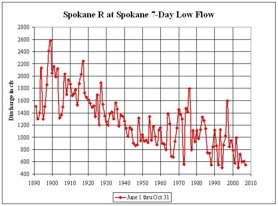
The Spokane River-Aquifer system provides an example of the problems of the municipal water law.  The attached graph, charting the lowest annual flow in the Spokane River each year for the period 1891-2007, starkly illustrates a vanishing river.  Historically, low flows ranged around 1600 cubic feet per second (cfs), but in recent years have dropped to 600-700 cfs.  Blame for the lost 1,000 cfs is likely attributable to three causes: reduced spills from Post Falls dam, decreased snowpack in the upper watershed (caused by loss of forest canopy (i.e., clear-cutting) and climate change), and groundwater pumping.  Declining flows in the Spokane River are causing serious and expensive problems, including devastation of the native redband trout population, inadequate flows to dilute wastewater effluent, and loss of recreational opportunities. 


How does this connect to the municipal water law?  The relationship between the Spokane River and the Spokane Aquifer (sole source of drinking water in the Spokane-Coeur d’Alene region) is intimate, with a series of gaining and losing reaches culminating in substantial spring-fed discharge to the River. Pumping from wells adjacent to the River can cause near-term depletion of instream flows.  


The City of Spokane holds 147,000 acre-feet of ground water rights, of which 77,000 acre-feet have never been pumped.  Rights to this unused quantity were of questionable validity until enactment of the municipal water law.  Recent modeling shows that, as the City grows into its paper rights, Spokane River flows will drop by an additional approximate 220 cfs.  Ecology files establish that, when the agency issued massive paper water rights to the City of Spokane, it did not consider whether water was physically available, whether the water was actually needed, nor what the impacts of pumping the City’s rights would cause to flows in the River.  


Spokane River flows may improve with a new requirement that Post Falls dam increase its minimum discharge.  There has also been discussion about creating trust water rights to boost instream flows.


But here’s the catch. 


No matter how much water is restored to the Spokane River, the improvements cannot be maintained.  Rather, the City will take any increase in flows as it expands its pumping.  Moreover, despite the municipal water law’s ‘quid pro quo’ – the requirement that water purveyors set and implement conservation goals – the City has made no effort to curb or offset the harm to the River that will result from increased municipal pumping.  On the contrary, the City has taken ultra-conservative positions in flow setting negotiations (for example, proposing 425 cfs as a summer minimum flow), driven by a stated desire to avoid responsibility for mitigating impacts to the Spokane River.


The municipal water law exacerbates the state’s long-standing practice of over-allocating water resources – and then makes it impossible to cure the problem.  This issue is not limited to Spokane, but repeats itself throughout the state.  For example, restoration of freshwater flows in Puget Sound watersheds, a topic of discussion in the Puget Sound Partnership process, will not be possible given the large number of paper municipal water rights in the region, and the loss of stream flow that will result as those rights are put to use. 


The water rights that purveyors hold on paper today represent water that is now flowing in rivers or aquifers.  Depleted rivers and consequent habitat loss, water quality degradation, and destruction of recreational values – these problems will only worsen as the full impact of pumping paper water rights, allegedly now valid under the municipal water law, removes more water from already over-allocated streams and rivers throughout Washington.


Rachael Paschal Osborn is executive director of the Center for Environmental Law & Policy, a public interest organization dedicated to protection of rivers and aquifers throughout Washington and the Columbia River watershed.  CELP is a plaintiff in the Burlingame v. State lawsuit. Rachael can be reached at 509-209-2899 or rosborn@celp.org.


1891-2007 dropping flows.  River flows have been declining for more than 100 years even as pumping from the Spokane Aquifer has increased.  The chart shows a decrease of about 1,000 cubic feet per second at the Monroe Street Bridge, where measurements have been taken since 1891.  (Source:  Washington Dept of Ecology)

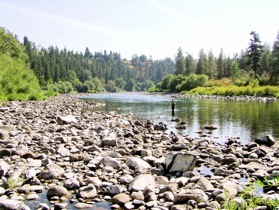
Fishing among the rocks, Spokane River (in the West Central Neighborhood).  The river supports an uncommonly fine urban fishery that is in peril.  (photo:  John Osborn)

Updated June 22, 2008


Big Win for  Rivers, Aquifers, & Existing Water Users


Judge issues landmark water decision


Decision impacts municipal water rights, WSU


On June 11, a state judge struck down key parts of a 2003 water law that would have allowed drastically expanded water use for development. The “Municipal Water Law” redefined private developers as municipalities and retroactively allowed developers and municipalities to increase their use of water under paper water rights at the expense of other water users and rivers and streams.


This ruling affects every water right holder who has a certificate based on system capacity or “pumps and pipes” instead of actual use. Judge Jim Rogers of the King County Superior Court held that actual use of water is the standard in Washington. Any water right based on pumps and pipes is now suspect.


Municipal water rights, like every other water right, are subject to legal tests intended to protect other water users and the environment.  With this ruling, the state can finally evaluate paper water rights under these legal tests and ensure orderly and responsible development of state water resources.  If municipal water rights fail the test, then they lose the right.


In challenging the law, CELP joined with Sierra Club, Washington Environmental Council, Puget Sound Harvesters, six western Washington tribes and several individual water right holders.  CELP and its co-plaintiffs are represented by attorneys Shaun Goho and Kristen Boyles of EarthJustice.


    On September 1, 2006, Center for Environmental Law & Policy, Sierra Club, Washington Environmental Council, Puget Sound Harvesters and several individuals to challenge HB 1338, the Municipal Water Law enacted in 2003 that allows municipalities to access huge water rights regardless of impacts on Washington’s rivers and aquifers.   In December 2006, six western Washington tribes filed a similar suit and the two cases have been consolidated and scheduled for hearing in King County Superior Court in the spring of 2008.  CELP and its co-plaintiffs are represented by attorneys Shaun Goho and Kristen Boyles of EarthJustice.  Click here to view copies of the Tribes’ complaint and Conservations’ Complaint.

    In sum, HB 1338 expands the definition of municipal water suppliers to include private water companies, developers, mobile home parks and any entity that serves 15 or more hook-ups.  The statute confers on these entities the ability to expand water usage without any review for impacts to rivers and aquifers or other water users.  As a result, Washington’s waterways are being seriously impacted by municipal over-pumping.  It will be virtually impossible to restore flow to our local waterways as municipal purveyors expand their pumping and usage.

    In a similar case, Sierra Club Palouse Group, Palouse Water Conservation Network and an individual have appealed the transfer of water rights held by Washington State University that will allow WSU to triple its pumping in order to serve a new golf course.  WSU pumps from the Grande Ronde Aquifer – an aquifer system that has been declining at the rate of 1 to 3 feet per year – an aquifer in crisis.  For more information, click here.


http://columbia-institute.org/wsu/WSUhome/home.htmlshapeimage_8_link_0